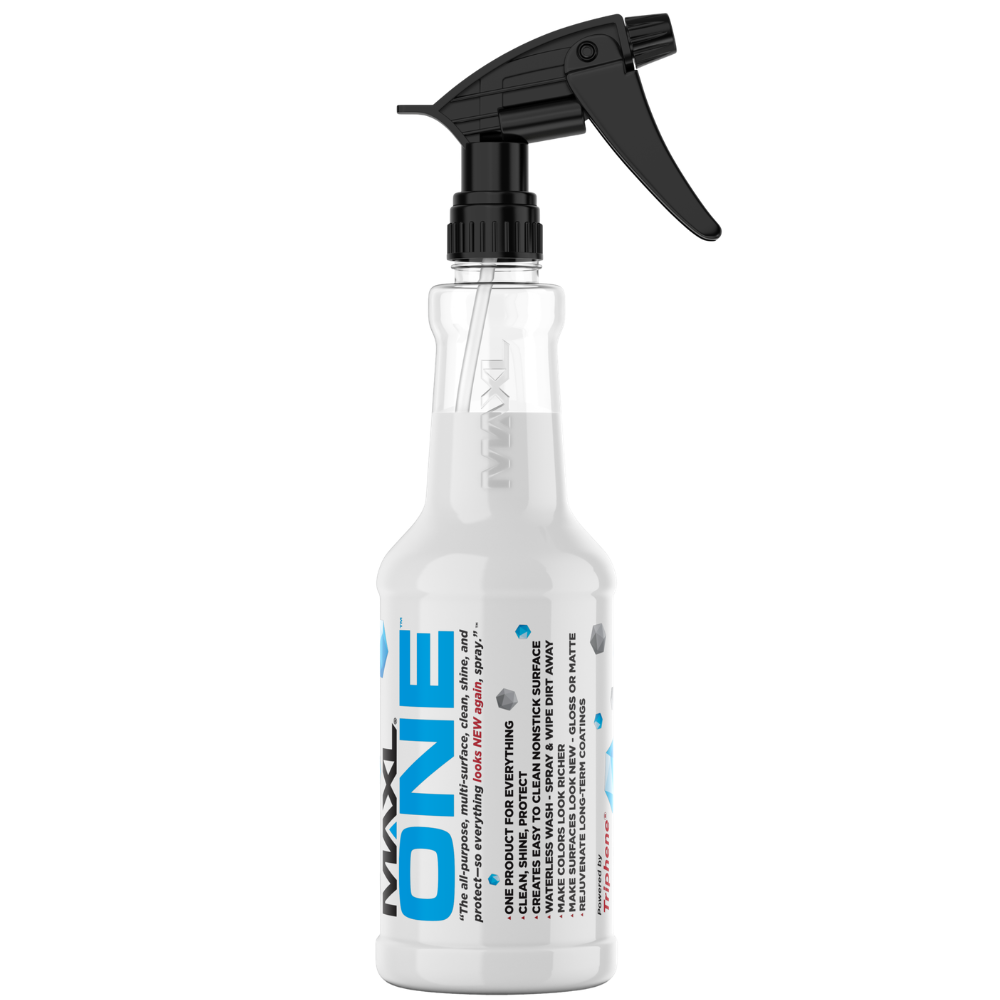
If you've spent any time on Instagram or YouTube lately, you've seen the MAXL ONE ads. Slick demos, big gloss claims, a proprietary-sounding "Triphene" technology, and a $60-70 price tag that suggests premium performance.
I'm a car care formulator. I've been making ceramic and graphene coatings for the better part of a decade. When a product gets this much marketing muscle behind it, my first instinct isn't skepticism — it's curiosity. What's actually in the bottle? Does it perform the way the videos suggest? And is it really a better product than what's already on the market?
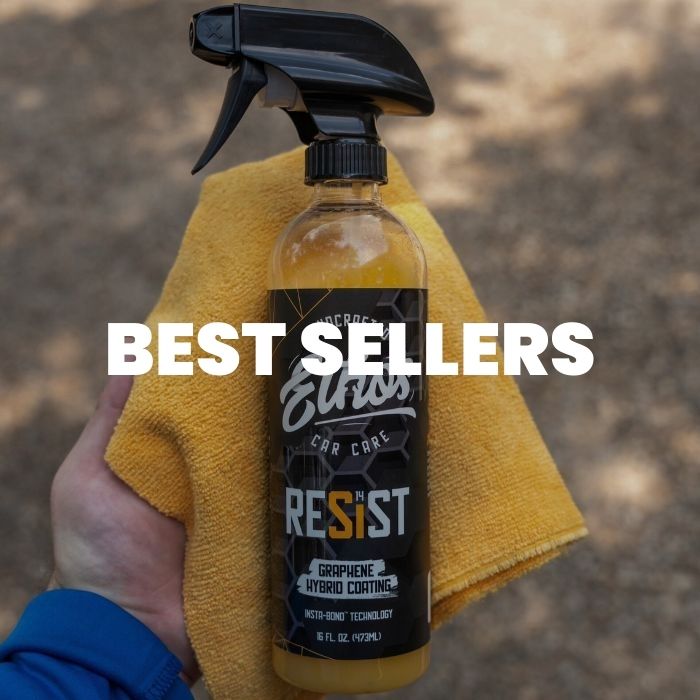
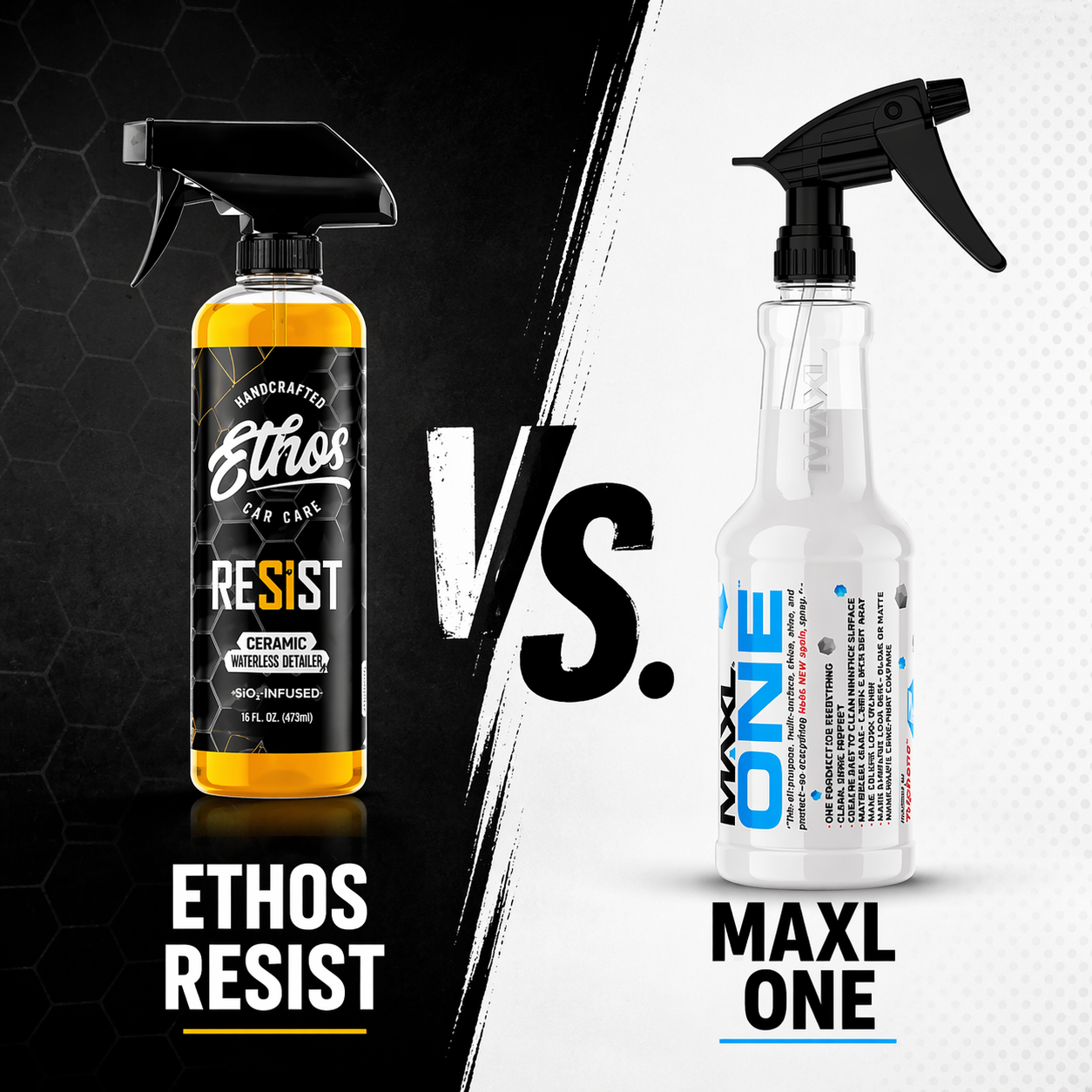
I bought MAXL ONE. I tested it against our own RESIST Graphene Spray Coating. The results weren't close.
Our take: MAXL ONE works. RESIST works better — longer protection, transparent chemistry, half the price per ounce, and real anti-static performance that MAXL's chemistry can't deliver. Every objective measure favors RESIST.
If you want chemistry you can verify, protection that actually lasts a year, and a price that doesn't punish you for caring about your car, RESIST is the answer. MAXL will protect your paint too — you'll just pay more for less, and reapply four to eight times as often.
Shop RESIST Graphene Spray Coating →
Why I Wrote This Comparison
I get emails every week asking about MAXL ONE. Usually from people who watched the ad, liked the demo, but aren't sure if it's worth $60+ per bottle. They want to know what's actually in it, whether the Triphene claims hold up, and whether they should spend the money.
So I'm going to answer that question directly — from the perspective of someone who formulates spray coatings for a living.
This is the part most review articles skip because it requires actually knowing what's in the bottles. It's also where the gap between MAXL and RESIST becomes obvious.
What "Triphene" Actually Means
MAXL describes Triphene as a "triple-layer self-assembling technology." It's a trademark, not a chemical name. You won't find "Triphene" in any chemistry textbook, patent database, or SDS glossary because it's a marketing label — not an ingredient.
That's not inherently bad. Every brand has proprietary names for their formulations. "Insta-Bond™" is ours. But it's important to understand:
“Triphene describes a branded product, not a unique molecule.”
Based on MAXL's published claims (hydrophobic, oleophobic, cross-linking polymers, electrostatic bonding, heat-resistant to 600°F), the formulation sits squarely in the hybrid silane-polymer quick-coating category — the same category that includes every $15 spray wax on the shelf, just repackaged at a premium. Independent reviewer CarXplorer reached the same conclusion after 30 days of testing: MAXL ONE is a "short-term automotive spray sealant" with "cross-linking polymers" that "create an electrostatic bond with the surface."
That's legitimate chemistry. It also isn't what the marketing implies.
What's in RESIST
I formulate RESIST, so I can tell you exactly what it is — ingredient by ingredient, mechanism by mechanism.
Reduced graphene oxide (rGO) — Graphene is a single-atom-thick sheet of carbon arranged in a hexagonal lattice. It's exceptionally slick, electrically conductive (which is what reduces static cling and dust attraction — a real chemical mechanism, not a marketing claim), and thermally stable. "Reduced" graphene oxide is the version of graphene that can actually be suspended in a liquid coating — pure graphene isn't processable.
Silicon dioxide (SiO₂) ceramic resins — The hardness and UV resistance component. SiO₂ is the standard ceramic coating chemistry used across the entire professional detailing industry. It's what gives ceramic coatings their scratch resistance and chemical stability.
Our Insta-Bond Technology™ — A proprietary nano-polymer carrier system that lets the rGO and SiO₂ disperse and bond on contact, without the 24-hour cure window traditional ceramic coatings require.
RESIST is a hybrid graphene-ceramic coating . Every ingredient has a named mechanism. Every performance claim traces back to a specific chemical property. You don't have to trust a trademark — the chemistry speaks for itself.
RESIST under the microscope — graphene + SiO2 hybrid chemistry. Which Chemistry Is Better?
The honest answer is RESIST, and it's not close:
Graphene's anti-static property reduces dust accumulation between washes. MAXL's hybrid polymer chemistry doesn't have this mechanism — it's not in the formula, because polymers don't do that. Daily drivers feel this difference within a week.
SiO₂ delivers true ceramic hardness and UV stability. Polymer sealants like MAXL don't match SiO₂ on scratch resistance or long-term chemical resistance. They can't — different molecule class.
Insta-Bond cures on contact. No 30-minute dwell, no 24-hour babysit window. Rain within the first hour doesn't compromise the bond. MAXL requires a cure window where any moisture ruins the application.
Single-mechanism vs hybrid. MAXL ONE is a hybrid polymer-silane sealant — one protective mechanism. RESIST combines three (graphene slickness + SiO₂ hardness + polymer carrier). More mechanisms, more protection axes, longer life.
Both products will bead water on day one. Past that, the chemistry gap widens fast.
Applying MAXL ONE
Per MAXL's own documentation, the application is:
- Light mist (half-trigger pulls)
- Wipe with microfiber
- Buff with a second dry microfiber for final finish
- Work in small sections
- Avoid moisture during cure window
Applying RESIST
RESIST's application process:
- Shake well
- Spray 2-3 mists per 2ft × 2ft panel onto a cool, clean surface
- Spread with a microfiber applicator
- Wait 30 seconds
- Buff with a clean, dry microfiber
The Insta-Bond™ advantage: RESIST cures on contact. No 30-minute dwell, no 24-hour garage storage, no "don't drive the car in the rain" anxiety. Rain within the first hour doesn't compromise the bond.
Full-vehicle application: 20-25 minutes for a midsize car. Drive it immediately after.
Ease-of-Use Edge: RESIST
Both products use the same basic workflow. The difference is what happens AFTER you buff: MAXL needs you to protect the cure window; RESIST is already cured. For anyone who doesn't have a climate-controlled garage, this is a material quality-of-life improvement.
PART 03 DURABILITY & REAL-WORLD PERFORMANCE This is where marketing claims meet asphalt.
MAXL ONE's Durability Claims (vs. Reality)
MAXL's marketing says protection "lasts months (or up to a year in ideal conditions)."
Independent testing says something different. In CarXplorer's 30-day real-world test on a daily-driven Acura, the reviewer found that "the topical coating begins degrading after four weeks" and concluded MAXL ONE is "an excellent quick detailer rather than a multi-year ceramic replacement."
Translation: MAXL's marketing says "up to a year." Independent testing says four weeks. It's a quick-detailer sealant — a category where 4-8 weeks of meaningful protection is typical, and where you'd normally spend $15-25 per bottle, not $60-70.
RESIST's Durability Claims (vs. Reality)
We claim 12+ months of standalone protection. That's backed by customer reviews (4.84/5 stars across 430+ reviews) and by an independent 6-month field test on a black daily driver in Central Texas that found "measurably less dust accumulation, tighter water beading, better gloss retention, and longer effective protection than a comparable pure ceramic spray."
Caveat: 12+ months assumes two initial coats applied correctly on prepped paint. Single-coat areas soften around month 7-9. Double-coated areas hold strong performance through month 12+. Even the conservative single-coat number beats MAXL's independent-tested durability by 2-3×.
Durability Verdict: RESIST Wins by 3-12×
MAXL ONE (per independent testing): 4 weeks of meaningful protection
RESIST (per independent testing + 430+ reviews): 12+ months with two-coat application, 7-9 months conservative single-coat
If you want a product for weekly refreshes, both work. If you want something you can apply and forget about for a year, RESIST was designed for that use case. MAXL wasn't.
Months of Protection — Independent Testing
This is where the gap stops being subtle.
MAXL ONE Pricing
20oz bottle: ~$60-70 regular
Gallon kit: $139.97 (promotional, listed from $191.94)
Per-ounce cost: ~$3.00-3.50 per oz at the 20oz size
RESIST Pricing
16oz bottle: $29.95 promotional ($59.95 MSRP)
128oz (gallon): $129.95 in Full System bundle
Buy 2 Get 1 Free: $59.99 for three 16oz bottles ($20/bottle)
Per-ounce cost: ~$1.87 per oz at the 16oz promotional price
The Cost Math Per Vehicle
Coat a midsize sedan (≈4oz of product for a two-coat application):
MAXL ONE cost per application: ~$12-14 of product used
RESIST cost per application: ~$7.50 of product used
Now multiply by reapplication frequency:
MAXL ONE (4-6 week cycle per independent testing): 3-4 bottles per year = $180-280/year
RESIST (12+ month cycle): 1 bottle per year = $29.95/year
THE MATH 6–10× Better cost-per-year of protection with RESIST
This isn't cherry-picking — it's the same math any CFO would run. MAXL charges premium pricing for short-term quick-detailer performance. That's the math, not a marketing claim.
Ready to put the math to work? RESIST ships the same day from our USA warehouse. 12+ months of protection in one 16oz bottle — no reapply cycle, no reorders.
Shop RESIST → Water beading after one application — RESIST at work. PART 05 WHO SHOULD BUY WHICH? Here's the honest decision framework — tilted toward where the product actually performs best.
MAXL ONE
Choose if…
Brand loyalty matters more to you than durability, chemistry transparency, or cost
You genuinely enjoy the weekly/monthly detailing ritual and want a quick-detailer on hand
You want a product specifically marketed to work on interior plastics in the same bottle
RESIST
Choose if…
You want 12+ months of protection from a single application
You want to spend $30-60 per year instead of $180-280
You want transparent chemistry — graphene (rGO) and ceramic (SiO₂), no trademark blanket over the ingredients
You want real anti-static performance that keeps dust off the paint between washes (graphene's actual property — not a marketing claim)
You're coating multiple vehicles, a family fleet, or a detail shop
You want to buy from the formulator who makes the product, not a middleman with a marketing budget
You're a daily-driver owner who cares about cost-per-year of protection
Shop RESIST Graphene Spray Coating →
A Note on "Alternatives" vs "Dupes"
Some of you searched "MAXL ONE alternative" or "MAXL ONE dupe" to land on this page. To be clear about what RESIST is and isn't:
RESIST is not a MAXL ONE dupe. We don't reverse-engineer competitor products. RESIST was developed independently from our own graphene-ceramic research — and launched before MAXL launched MAXL ONE.
If anything, MAXL is a premium-priced late entry to the category RESIST already defined. Both are all-in-one spray coatings. Only one is built around graphene's actual chemistry instead of a proprietary-sounding trademark. You choose.
Frequently Asked Questions
Is MAXL ONE a real ceramic coating?
No — not in the traditional sense. MAXL ONE is what the industry calls a "quick detailer sealant": a sprayable hybrid polymer-silane product that creates a protective layer on contact. It's a category step below professional 9H-rated ceramic coatings, closer in chemistry to a $15-25 spray wax than to a real ceramic coating. The $60-70 price tag doesn't change what's in the bottle.
What is Triphene technology?
Triphene™ is MAXL's branded trademark for their proprietary formulation. It's not a chemical ingredient you can verify — it's a marketing label on a hybrid polymer-silane sealant. Based on MAXL's own published performance claims, the underlying chemistry is standard quick-detailer sealant, not a novel molecular innovation.
Is RESIST cheaper than MAXL ONE?
Yes, significantly. RESIST's 16oz bottle at $29.95 promo works out to about $1.87/oz. MAXL ONE's 20oz bottle at $60-70 works out to about $3.00-3.50/oz. Per ounce of product, RESIST is 40-50% less expensive. Factor in RESIST's 12+ month protection cycle vs MAXL's independently-tested 4-6 weeks, and the cost-per-year of protection favors RESIST by roughly 6-10×.
Which is better for a daily driver?
RESIST, decisively. 12+ months of protection vs 4-6 weeks for MAXL (per independent testing) means you apply RESIST once a year instead of eight times. Graphene's anti-static property also keeps dust off the paint between washes — MAXL doesn't have that mechanism in its chemistry. For outdoor-parked daily drivers, the performance gap isn't subtle.
Can I use MAXL ONE and RESIST together?
No practical benefit to doing so. Both are hydrophobic topcoats; layering one over the other doesn't double your protection. If you've applied MAXL ONE and want to switch to RESIST, wait until MAXL has naturally worn off (typically 4-8 weeks), prep the paint (wash, iron decon, panel prep), and apply RESIST. After that, you're on the 12+ month cycle.
Is RESIST safe on all the same surfaces as MAXL ONE?
Yes. RESIST is safe on paint, glass, wheels, headlights, trim, and chrome. Test on hidden areas first for unusual plastic trims or specialty finishes. Unlike MAXL, we don't recommend RESIST for interior soft surfaces (leather, fabric) — we make dedicated interior products for those applications.
How long does MAXL ONE actually last?
MAXL's marketing claims "months to a year." Independent testing by CarXplorer measured degradation beginning at the 4-week mark on a daily-driven vehicle. Realistic expectation: 4-8 weeks of strong performance, with reapplication every 4-6 weeks to maintain protection.
What makes RESIST different from other graphene sprays?
Two things. First, RESIST actually contains measurable reduced graphene oxide (rGO) — many "graphene" sprays use the word as marketing without real graphene content. Second, Insta-Bond cures on contact instead of requiring a 24-hour cure window. Apply RESIST and drive immediately.
THE FINAL WORD
The Bottom Line
MAXL ONE works. It protects paint. It beads water. It's also a short-term quick-detailer sold with heavy marketing at premium pricing — not the multi-year ceramic protection the branding implies.
RESIST is a hybrid graphene-ceramic coating with transparent chemistry, 12+ months of single-application protection, real anti-static dust reduction from graphene's actual chemical property, and a price that works out to roughly half per ounce.
For nearly everyone — daily drivers, enthusiasts, multi-vehicle owners, anyone who runs the cost-per-year math — RESIST is the better product . The only reason to choose MAXL instead is if brand loyalty outweighs every objective measure of performance and value.