




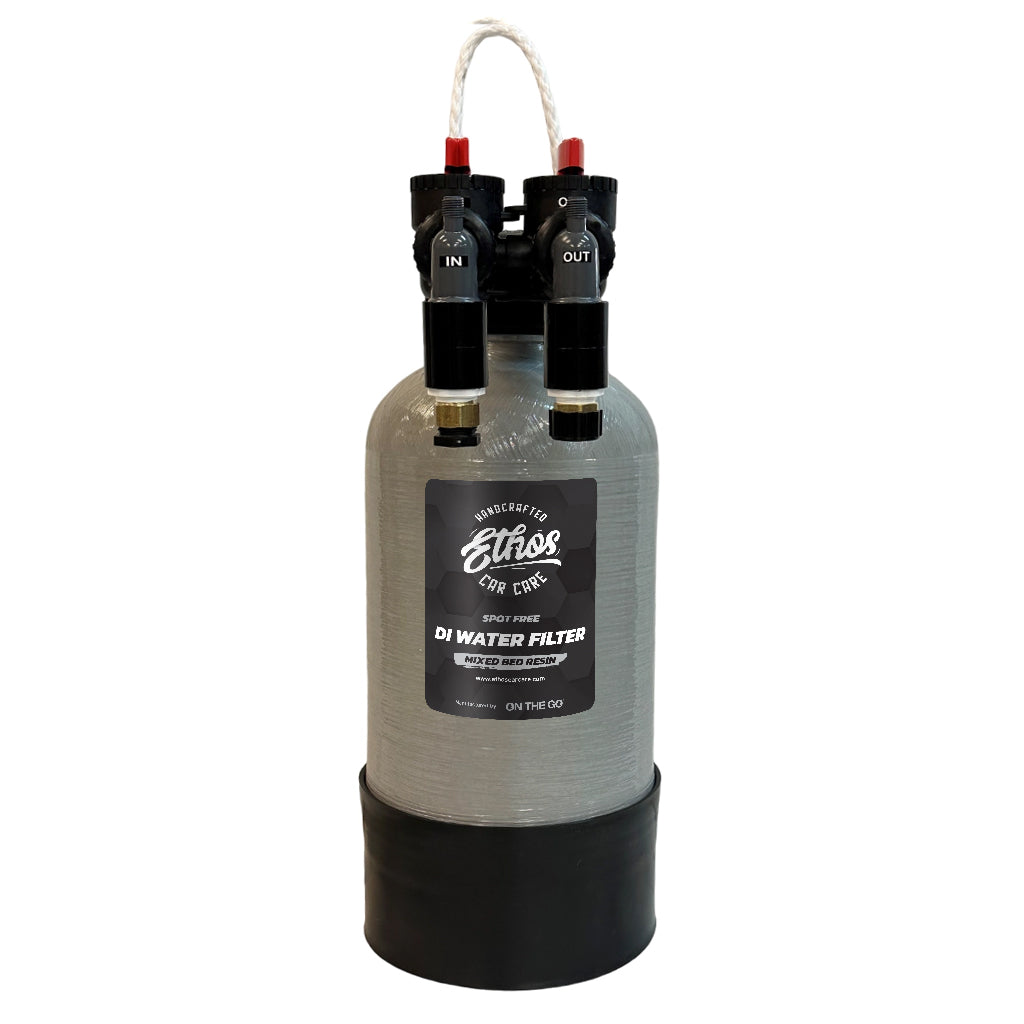
Why DI Water Wins for Detailing
Tap water leaves mineral spots because it carries dissolved ions. Deionized (DI) water removes those ions, so panels dry nearly spot-free—no frantic towel chase, no micro-marring. For pro detailers and serious enthusiasts, a DI water system is the cleanest upgrade to any wash workflow.
The #1 Failure Mode: Exceeding the 3 GPM Flow Rate
Your DI system’s performance lives and dies by contact time in the resin bed. Our system’s maximum flow rate is 3 GPM. Go past that and you reduce contact time, channel the bed, and let ions slip through—leading to faster resin exhaustion and … spots.
Quick rules of thumb
-
Keep ≤ 3 GPM for the DI final rinse.
-
If you love pressure: perform the high-pressure rinse on tap/softened water, then switch to low-flow DI for the final sheet-off rinse.

What a TDS Meter Really Measures (and Doesn’t)
A TDS meter doesn’t directly measure solids—it measures electrical conductivity (EC). Dissolved salts, minerals, and metals become ions (charged particles) that carry electricity; more ions → higher conductivity → higher “TDS.”
Limitations of TDS
-
It can’t identify which ions (e.g., Ca²⁺ vs Na⁺, Cl⁻ vs SO₄²⁻).
-
Equal TDS values can exhaust resin very differently depending on ion mix.
-
Only lab analysis can reveal exact ionic composition—overkill for most users.
Use TDS as a guide, not gospel: monitor outlet readings and performance trends, not just a single number.
How Mixed-Bed Deionizers Work (Resin Chemistry)
A mixed-bed deionizer blends two resins so ion exchange happens side-by-side, producing low-conductivity water.
-
Cation Exchange Resin (H+ form)
Exchanges H+ for Ca²⁺, Mg²⁺, Na⁺, K⁺, Fe²⁺, etc. (attacks hardness). -
Anion Exchange Resin (OH- form)
Exchanges OH- for Cl⁻, SO₄²⁻, NO₃⁻, HCO₃⁻/CO₃²⁻, and others (salts & anions). -
The payoff
H+ + OH- → H₂O (pure water). Mixed-bed geometry reduces ionic “leakage” and yields consistently low TDS.

Running separate “dual-bed” tanks? Cation must precede anion. Anion-first elevates pH (OH- in hard water) and precipitates CaCO₃/Mg(OH)₂ inside the bed—fouling, pressure drop, wasted capacity. Mixed-bed designs avoid this sequencing failure by design.
DI vs. Water Softeners (Complementary, Not Competing)
| Feature | Water Softener (Na⁺/K⁺ form) | Deionizer (Mixed Bed) |
|---|---|---|
| Removes hardness (Ca/Mg) | Yes (exchanges for Na⁺/K⁺) | Yes |
| Removes all ions (incl. chloride, sulfate, nitrate) | No | Yes |
| Residual spotting | Reduced but possible | Minimal/none (near-zero TDS) |
| Best use | Whole-home/whole-wash hardness control | Final rinse for spot-free finish |
| Maintenance | Brine regeneration cycles | Resin replacement/recharge |
Takeaway: A softener makes soaps work better and reduces mineral load. DI is the finisher that delivers a true spot-free dry.
What Actually Determines Resin Life
Resin exhausts from inlet to outlet as an “exhaustion front” moves through the bed.
Major variables
-
Influent TDS and ion mix: 250 ppm sodium ≠ 250 ppm calcium + sulfate.
-
Flow rate: Respect ≤ 3 GPM to protect capacity.
-
Silica: Often the final “sticking point” that can leave micro-spots even at low TDS.
-
Bed depth & distribution: Proper bed depth and even flow reduce channeling.
-
Temperature & CO₂: Can shift pH/carbonate balance and influence readings.
When to change resin: When outlet TDS climbs from near-zero into ~10–20 ppm and you begin to see faint spots in your real-world dry-down.
Sizing & Operating Your DI Setup (Practical Framework)
-
Measure source TDS (handheld).
-
Decide usage: final rinse only (recommended) vs full wash through DI.
-
Choose bed volume for your throughput and tolerance for swap frequency.
-
Enforce ≤ 3 GPM (use a restrictor, low-flow nozzle, or ball-valve discipline).
-
Pre-filter (5–20 µm sediment; optional carbon) to protect the bed and your meter.
Best practices
-
Sequence: Tap/softened for wash & blast → DI final rinse at ≤ 3 GPM.
-
Post-use flush: 10–20 seconds helps re-wet the bed and reduce channeling.
-
Store upright & frost-free.
-
Sanitize if idle long term (fresh water circulation to deter biofilm).
-
Inline metering: Place TDS meter after the DI outlet; dual-port meters can show in/out delta.
Troubleshooting (Rising TDS or Spots, Even When “Low”)
-
Flow too high? First suspect—dial back to ≤ 3 GPM.
-
Silica lingering? Slow the final pass, emphasize sheeting, and consider earlier resin swaps.
-
Chloride/sulfate-heavy water? Anion portion may exhaust first; replace resin sooner.
-
Channeling from storage/pressure spikes? Keep upright, avoid water hammer, use gentle open/close.
-
Metallic fittings contaminating? DI is “hungry”; swap questionable nozzles/fittings.
FAQs
What TDS number gives spot-free results?
As close to 0 ppm as practical. Many are satisfied under 10 ppm; perfectionists swap earlier.
Can I run a pressure washer through DI?
Only if you can guarantee ≤ 3 GPM. The safer workflow is pressure on tap/softened, final DI at low flow.
Does a softener replace DI?
No. Softeners handle hardness; DI handles both cations and anions for truly spot-free drying.
Why do I get faint spots at very low TDS?
Often silica or spray pattern/turbulence. Slow the final pass and let water sheet off panels.
The Best Part—A System That Just Works
Ready for simpler washes and spot-free drying? Get the kit built for detailers, with the right flow guidance and resin capacity to do the job right the first time.
👉 Shop: Ethos Spot-Free Deionizing Water System
Product page: https://ethoscarcare.com/products/spot-free-deionizing-water-system
-
Built around mixed-bed resin for ultra-low TDS.
-
Designed to be used at ≤ 3 GPM for maximum capacity and purity.
-
Easy maintenance with drop-in resin refills and optional inline TDS monitoring.
-
Ideal for final rinse workflows that save towels, time, and paint.
Related add-ons
-
Replacement Mixed-Bed Resin Cartridges
-
Inline or Handheld TDS Meters
-
Sediment/Carbon Pre-Filters