



Most “Graphene” Coatings Are Ceramic
With Powder Stirred In.
Here's the Chemistry That Isn't.
In June 2020 we released the first consumer graphene coating. Since then, “graphene” has become the most abused word in detailing. This page is the full technical story — the molecule, the bond, the test data — with nothing hidden. Because customers who do it right deserve to know exactly what's in the bottle.

Why Your Paint Loses — and Why Wax Was Never Going To Save It
Automotive clear coat is under constant chemical attack: UV photo-oxidation dulls the resin, acidic bug and bird deposits etch it, hard-water minerals bake into it, and every wash drags grit across it. Carnauba wax survives weeks. Polymer sealants survive months. SiO2 ceramic coatings changed the game in the 2010s by covalently bonding a hard silica film to the paint — but silica brought two failure modes of its own: it crystallizes as it cures (making high spots permanent and application unforgiving), and its silica surface has a chemical affinity for hard-water minerals — which is why water-spot etching is the #1 complaint on ceramic-coated cars.
Solving those two failure modes is why we spent years on graphene.
The Molecule: One Atom Thick, 200× Stronger Than Steel
Graphene is an allotrope of carbon — graphite processed down to a single layer of atoms arranged in a two-dimensional honeycomb lattice, forming a nearly transparent sheet. It was isolated in 2004 by Andre Geim and Konstantin Novoselov at the University of Manchester, who received the 2010 Nobel Prize in Physics for it. At the molecular level it is roughly 200× stronger than steel yet six times lighter and flexible; thermally more conductive than diamond; electrically more conductive than silver; and among the most impermeable materials ever measured. Turned sideways, a graphene sheet would be virtually invisible.

How a Real Graphene Coating Is Made
Graphene on its own cannot form a coating. It is chemically inert and non-reactive — a flat plane with nothing to bond to your clear coat with. So you must be thinking: “Graphene sounds amazing — why doesn't everyone just put graphene on their cars?” Because making it usable takes real chemistry, in real reactors:
Step 1 — Oxidize it. Graphite is refined into graphene oxide (GO): oxygen and hydroxy groups are bonded onto the carbon lattice (think zinc oxide — a metal oxide — but built on carbon). This is the critical step that makes the sheet dispersible and reactive. The trade-off: the oxygen disrupts the lattice, leaving GO weakened, thermally unstable, and electrically insulating (under 1 µS/m at a carbon-to-oxygen ratio near 2).
Step 2 — Reduce it. The GO is further refined — impurities removed, atoms stripped and added with precision — into reduced Graphene Oxide (rGO), pushing the C/O ratio past 6 and partially restoring the aromatic hexagonal structure: the strength, the thermal stability, the anti-static conductivity.
Step 3 — Graft it. The remaining hydroxy sites on the rGO work like molecular velcro: they're what our silazane ceramic backbone grafts onto, carrying the graphene into a film that bonds to paint, glass, wheels, and plastics.


1. Eftekhari, A.; Garcia, H. (2017). “The Necessity of Structural Irregularities for the Chemical Applications of Graphene.” Materials Today Chemistry 4: 1–16. doi:10.1016/j.mtchem.2017.02.003.
The rGO In Every Bottle, By the Numbers
Ceramic vs. Graphene: Two Houses, Two Foundations
“Ceramic” at its simplest refers to inorganic chemistry — in coatings, primarily SiO2, TiO2, or silicon carbide. Graphene Matrix™ is fundamentally a carbon-based coating: a reduced Graphene Oxide structure with inorganic elements built onto it to enable bonding. Strictly speaking that makes it a hybrid coating — organic and inorganic chemistries combined — not a ceramic. Ceramic coatings are fundamentally modified silicon; graphene coatings are fundamentally modified carbon. Close neighbors on the periodic table — entirely different substances. Both are houses. They're built on entirely different foundations.
Is it just a ceramic with graphene added?
No — and here's the chemistry of why that shortcut fails. Adding graphene powder, or even graphene oxide, to a finished ceramic coating skips the reaction that makes graphene useful: nothing grafts it to the film, so it causes no behavioral change at all. It just floats there. If a marketing angle was how our technology worked, it would have saved us the expensive reactors and processing these molecular structures actually require.
The structural difference shows up on your paint: a silica film is dense with reactive hydroxy sites — which is exactly where hard-water minerals attack. The finished graphene surface presents fewer reactive sites: less for water spots and contamination to key into.
| Graphene Matrix™ | Traditional Ceramic | |
|---|---|---|
| Chemistry | Carbon (rGO) hybrid | Silica (SiO2) |
| Durability | 5–10 years by tier | 1–2 years typical |
| Water contact angle | 110–118° | 100–110° |
| Hardness | 9H | ≤ 9H |
| Water-spot etching | Highly resistant (fewer reactive sites) | Prone — silica + hard water |
| Cured film | Flexible — forgiving install | Crystallizes — permanent high spots |
| Maintenance | pH-neutral wash, standard toppers | Often needs special cleaners |
Why ceramic-based maintenance products still work on it
Carbon and silicon sit beside each other on the periodic table and share real chemical kinship — which is exactly why we engineered Graphene Matrix™ to accept silica-based maintenance chemistry. Our go-to wash for any graphene coating is Cleanse — our graphene-infused shampoo, which revitalizes the coating and tops up graphene protection with every wash. And your existing Ceramic Shampoo, Defy, and toppers bond happily to the surface too. New technology shouldn't force you to re-buy your whole shelf.
What the Chemistry Does On Your Car
1 · Hydrophobics you can measure
Water repellency is quantified by water contact angle — the angle a droplet's edge makes with the surface. Higher angle = taller droplet = less contact area = less gripping, spotting, and staining. Fresh-applied, Graphene Matrix™ measures 118° against roughly 110° for conventional SiO2 ceramics — bigger, tighter beads that roll off the surface pulling debris with them: a genuine self-cleaning effect.

2 · Durability proven in wash cycles, not adjectives
In our internal scrub-cycle testing (ASTM-style wash simulation on automotive clear coat), Graphene Matrix™ held a 90°+ contact angle after 2,000 scrub cycles. A comparable ceramic's hydrophobics diminished after 1,000. We publish wash-cycle ratings on every coating tier — 1,000+ washes on Matrix 3.0, 5,000 on PRO 3.0 — because “years of protection” means nothing without a wash count behind it.

3 · Water-spot etching, mostly engineered out
Fewer reactive surface sites + a non-crystallizing film + water shed before it dries: our installs have shown up to an 80–95% reduction in water-spot etching versus silica ceramics. Watch it tested:

4 · Anti-static: the clean-car cheat code
Paint surfaces build static charge — and charged surfaces attract dust like a magnet. Because reduction restores rGO's conductivity (>500 S/m), the graphene surface layer dissipates static instead of holding it. Your car collects visibly less dust between washes.
5 · Thermal stability: born for wheels
Graphene conducts heat better than diamond. In the film, that means reduced heat absorption and dramatically slower heat-driven aging — why Graphene Matrix™ thrives on wheel faces living next to the brakes, and why our tire dressing is built on graphene too.
6 · One coating, every surface
Because graphene's atoms share such strong attraction to one another, the film lays down uniform and dense on paint, glass, metal, and plastic alike — a true one-size-fits-all chemistry with no need for specialized top coats. The cured film stays flexible: it moves with the panel, resists chipping, tolerates clay and light polishing during maintenance without losing integrity, and won't inhibit PPF's self-healing. And uniquely, we can run a high activity level (40% solids in Matrix 3.0) without making installation harder — the Achilles' heel of ceramic chemistry, where more actives always means a less forgiving install.
What To Expect — and What Not To
Expect: gloss in the upper 99th percentile, hydrophobics that make washing dramatically faster, multi-year verified durability, and ongoing compliments. This is a semi-permanent treatment that rewards consistent, simple maintenance.
Do not expect: a scratch-proof, etch-proof, contamination-proof force field. No graphene coating on earth is one — and anyone selling you one is lying. These are impressive feats of chemistry, but they do not reward neglect, abuse, or carelessness. It's an investment in your vehicle that pays back tangible results for those who do it right.
Proof, Not Promises
For the technically curious, start where we did: the hydrophobic graphene coating patent literature (WO2016076801A1), a primer on graphene oxide, and the Eftekhari & Garcia paper cited above. Every coating is formulated and bottled in-house in the USA — never private-labeled.
Technical FAQ
Is it safe on PPF and vinyl?
Yes — recommended. The flexible membrane seals film against UV yellowing without inhibiting self-healing.
How does it cure?
Ambient moisture cure: hydrolysis then polycondensation cross-linking. Flash in 1–3 minutes at 65–75°F, drive in 2 hours, water-safe in 24, full network density over several days.
Can it be layered?
Yes — two coats maximize film build and uniformity; beyond two adds nothing measurable.
Over an existing coating or wax?
No. The silazane backbone needs bare, decontaminated clear coat — anything between becomes the weak interface.
Can I keep using my ceramic maintenance products?
Yes — by design. Silica-based maintenance chemistry bonds readily to the graphene surface (see the periodic-table explanation above).
Glass and wheels?
Both. High heat tolerance for wheels; for windshields, our dedicated EZ Glass chemistry penetrates and cures within the glass structure itself.
Does it need professional installation?
No — no professional tools or experience required. Follow the included instructions and the how-to below:
How do I keep it alive?
Wash with Cleanse — our graphene-infused, pH-balanced coating shampoo — it cleans with ultra-slick surfactants while topping up graphene protection every wash. Add periodic toppers, and follow the full protocol in our coating maintenance guide.
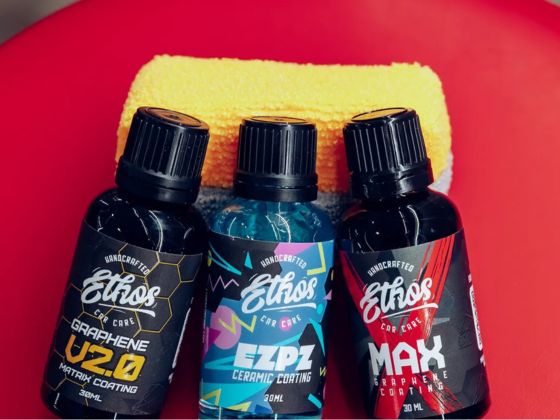
The Graphene Matrix™ Lineup
Every product below is built on the rGO platform you just read about — tuned by surface, solids load, and durability tier.


Handcrafted by Ethos in the USA. Formulated in-house — never private-labeled. For the Ones Who Do It Right.