

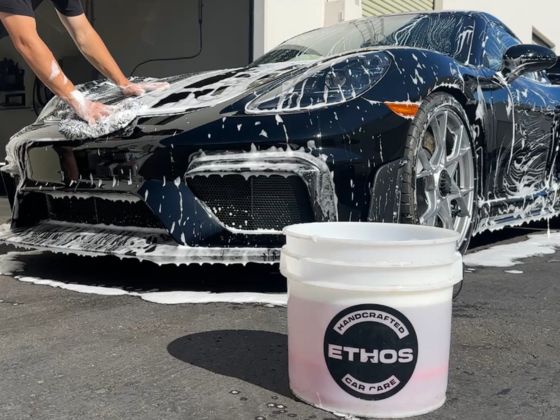
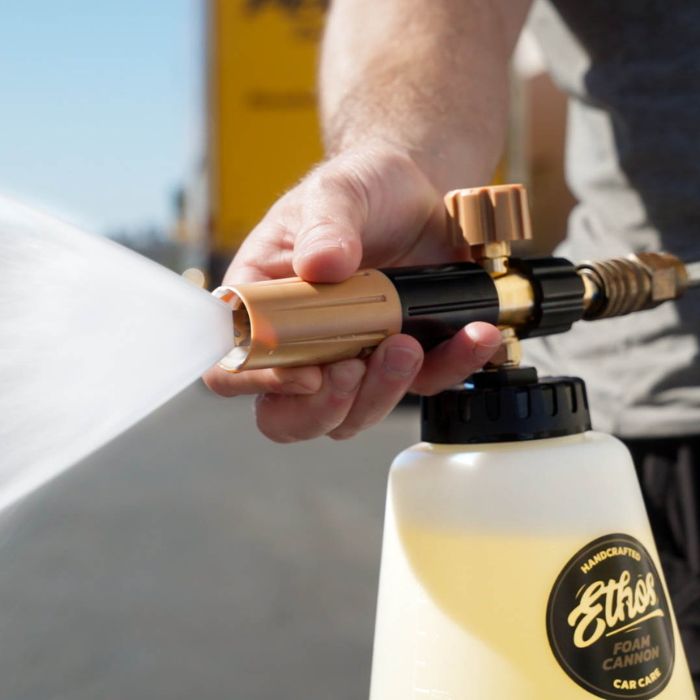
A foam cannon is the single biggest upgrade you can make to your wash routine — it turns your pressure washer into a machine that blankets the car in thick, clinging foam that lifts dirt off the paint before you ever touch it. That pre-wash step is the difference between washing safely and grinding grit into your clear coat.
But the market is flooded with foam cannons from $15 Amazon specials to $90 pro units, and from the outside they all look like the same bottle-and-nozzle. They are not. This guide breaks down what separates a great foam cannon from a shelf ornament, and which one to buy for how you actually wash.

What actually matters in a foam cannon
Four things determine whether a foam cannon foams thick or spits watery suds:
- Orifice size. The small brass disc inside meters water flow. A 1.25mm orifice suits most gas and higher-flow electric pressure washers; a 1.1mm orifice generates better foam on lower-flow electric machines. Cannons that include both work across every setup — cannons with one fixed orifice only foam well on the machines they happen to match.
- Brass vs. plastic internals. The core and fittings live under pressure, every wash. Brass cores last for years; plastic internals crack, strip, and leak — it is the #1 failure point on budget cannons.
- Air mixing design. Foam is soap, water, and air. Better cannons pull more air into the mix, which is why two cannons running identical soap can produce completely different foam thickness.
- Dilution control. A usable top dial lets you dial soap concentration to conditions — heavy foam for winter grime, lighter for maintenance washes.

Best foam cannon for pressure washers: our picks
Best overall for detailers: Ethos Foam Cannon Pro V2

Full disclosure — this is our cannon, so judge the reasoning, not the badge. The Foam Cannon Pro V2 is built around an all-brass core with both 1.25mm and 1.1mm orifices included, so it foams properly on gas washers and lower-PSI electric units alike (down to roughly 1,300 PSI). The air-mix design produces noticeably denser foam than the standard Amazon-tier design, the wide-neck bottle fills without a funnel, and the dilution dial actually holds its setting. It's the cannon we designed because we detail with it — paired with a pH-neutral soap like Ceramic Car Shampoo, it lays down foam that clings long enough to do its job.
Best budget pick: Tool Daily / Twinkle Star-style cannons
The interchangeable ~$20 Amazon cannons (Tool Daily's is the archetype) are honestly fine as a first foam cannon. They foam adequately on higher-flow machines and they cost less than a bottle of good soap. The tradeoffs are real, though: fixed single orifice (weak foam on electric washers), plastic-heavy internals that leak and strip with use, and dilution dials that drift. If you wash occasionally and want to try foaming before committing, start here — just know why the upgrade exists.
Best pro-shop unit: MTM Hydro PF22.2
The MTM Hydro PF22.2 is the standard in professional shops for a reason — excellent build, excellent foam, Italian-made. It's also priced like it (typically around $90) and set up for the high-flow machines pro shops run. For a home detailer with a consumer pressure washer, you're paying a shop premium for capability your machine may not use.
Also worth knowing
Chemical Guys' TORQ cannon and Adam's foam cannon are both competent mid-tier units from big brands — you won't go badly wrong with either. Their designs are conventional; you're largely paying for the logo on the bottle.
Quick comparison
| Cannon | Core | Orifices | Best for | Price tier |
|---|---|---|---|---|
| Ethos Pro V2 | All brass | 1.25mm + 1.1mm included | Home detailers, gas or electric | Mid |
| Tool Daily / budget | Plastic-heavy | Single, fixed | First-timers, occasional washers | Budget |
| MTM Hydro PF22.2 | Brass | High-flow oriented | Pro shops, high-GPM machines | Premium |
| Chemical Guys TORQ / Adam's | Conventional | Single | Brand loyalists | Mid |
Foam cannon vs. foam gun: which one do you need?
They are not the same tool. A foam cannon connects to a pressure washer and produces thick, shaving-cream foam. A foam gun connects to a garden hose and produces thin, runny suds — because a garden hose simply doesn't generate the pressure real foam requires. If you own a pressure washer, the cannon is categorically better. If you don't, a foam gun is a mild upgrade over a wash bucket, not a substitute for a cannon.
How to use a foam cannon (the short version)
- Add 1–2 oz of pH-neutral car soap to the bottle, fill the rest with warm water, and swirl — don't shake.
- Connect the cannon to your pressure washer gun's 1/4" quick-connect. A swivel gun makes this dramatically less annoying — the hose stops twisting as you move around the car.
- Foam the entire car top-down. Let it dwell 3–5 minutes — this is the step doing the work — but don't let it dry on the paint.
- Rinse top-down, then follow with a two-bucket contact wash while the surface is still lubricated.

For the full routine, see our car wash kits — the cannon, soap, and mitts matched as a system.
Frequently asked questions
Do foam cannons work with electric pressure washers?
Yes — if the cannon's orifice matches your machine's flow. This is exactly why a dual-orifice cannon matters: swap in the 1.1mm orifice and an electric washer in the 1,300–2,000 PSI range foams properly. Single-orifice budget cannons are tuned for higher flow and often disappoint on electric machines.
What soap should I use in a foam cannon?
A dedicated, pH-neutral car shampoo formulated to foam. Dish soap strips wax and sealants and foams poorly. If your car is ceramic or graphene coated, use a coating-safe shampoo like Ceramic Car Shampoo so you're not degrading the protection you paid for.
How much PSI do I need for a foam cannon?
Roughly 1,300 PSI and up with the right orifice. Flow rate (GPM) matters as much as pressure — 1.4+ GPM produces noticeably better foam.
Why is my foam cannon producing watery foam?
In order of likelihood: too little soap in the mix, the wrong orifice size for your machine, a clogged mesh filter inside the cannon, or a low-flow pressure washer at the edge of what the cannon supports. Warm water and a quality foaming soap fix more thin-foam problems than any hardware change.
Is a foam cannon worth it?
If you care about your paint, yes — the touchless pre-wash is the single most effective swirl-prevention step in a wash routine. It's not about the show foam; it's about lifting abrasive grit off the surface before your wash mitt ever touches it.
Build the complete touchless pre-wash system
Foam Cannon Pro V2 + EZ Pull Swivel Gun + Ceramic Car Shampoo — everything between your pressure washer and swirl-free paint.